
How will generative AI impact higher education?
An Opportunity Knocks deep dive.

By Andrew and Calvin Hunt (rising Princeton University senior)
The rapid adoption of Generative Artificial Intelligence (GenAI) - AI systems capable of generating text, images, music, video, code, and other forms of content in response to human prompts - fueled by an accessible and free version of ChatGPT, is the latest in a long history of inflection points in American higher education.
Colleges and Universities have frequently confronted transformative events since the founding of Harvard College 387 years ago.
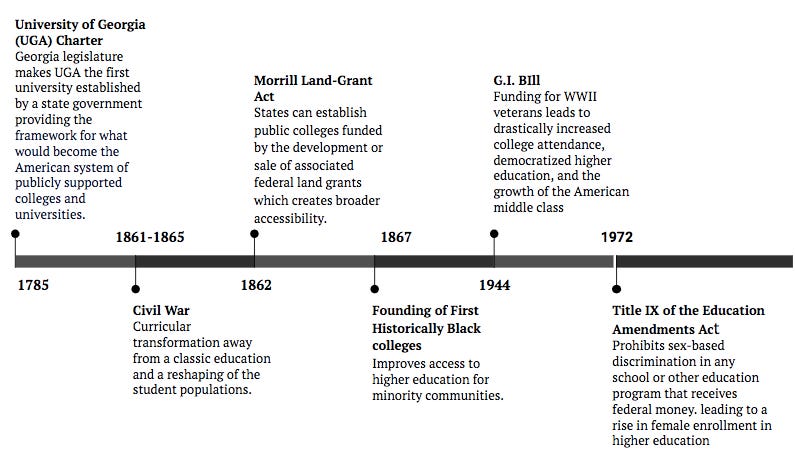
Other crucial inflection points include the establishment and growth of the elective system at Harvard in 1873-1874, the 1965 Higher Education Act, the emergence of online education, and the COVID-19 pandemic. Colleges and universities have also navigated social movements (e.g., Civil Rights and Counterculture) and economic shocks (e.g., The Great Depression and The Great Recession). Through it all, America's higher education system has been resilient, adapting to these one-off episodes and social, cultural, and economic shifts.
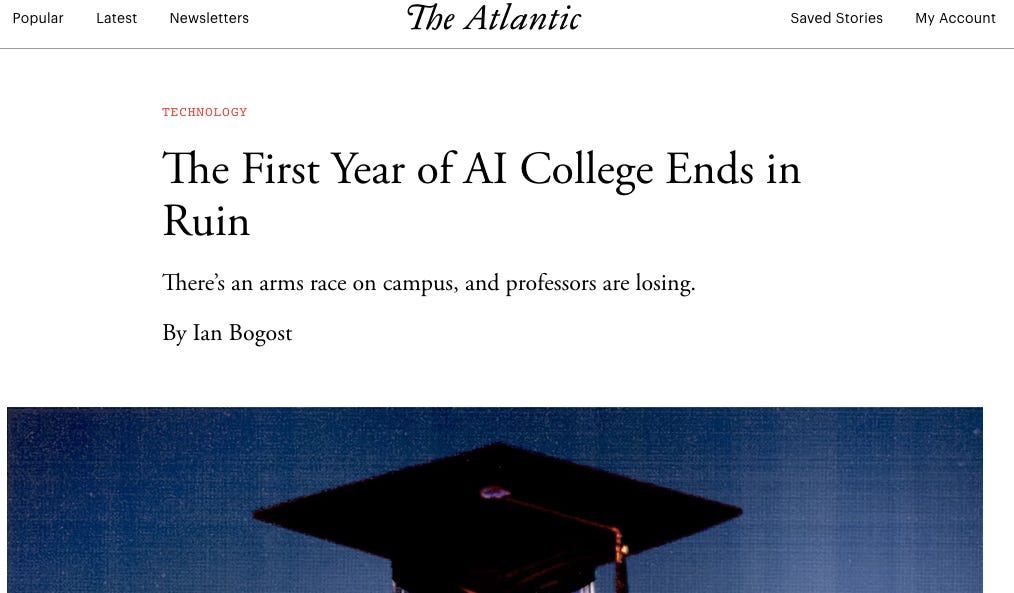
Given this history, does the adoption of GenAI represent a fundamentally destabilizing event for higher education? There is lots of speculation in academic literature (there are 2680 results on Google Scholar for “ChatGPT” and “Higher Education”) and doomy press coverage.
But to comprehensively consider this question, let’s assess what GenAI can do before turning to higher education applications.
Then we will move to the context in which higher education operates, specifically considering social, economic, and pedagogical trends.
Finally, we will delve into the adoption trends, perspectives, potential benefits, and risks of GenAI among the three primary stakeholders in higher education: students, faculty, and administrators.
What GenAI can do
First, what are we talking about when we talk about GenAI? GenAI is a distinct class of artificial intelligence systems capable of generating new outputs in response to human prompts. They identify complex relationships and patterns in massive training data sets and generalize findings to create new data. These training data sets are called large models (LM); they are the engines of GenAI systems. There are different types of LMs; for instance, Large Language Models (LLMs) generate text from text prompts, while multimodal models can generate images from text, images from images, etc. LMs are built by humans, and those you have heard of - e.g., ChatGPT, Bard, DALL-E - are trained on unimaginably large amounts of data. We’ve seen estimates that ChatGPT4 is trained on 300 billion words. If you want a more technical explanation of how GenAI and LMs work, check out this MIT explainer or Stanford lessons from a computer science course (even more technical).
What GenAI can do in Higher Education
So, specific to higher education, what can GenAI do? Let’s start by segmenting use cases into administrative/operational and academic buckets. We rely on a framework proposed by Mark Maby from Info-Tech Research Group to determine whether GenAI can significantly enhance a use case.
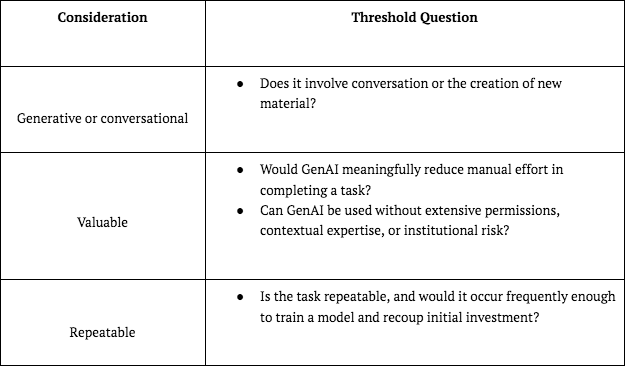
In line with this framework, Maby suggests GenAI may augment the following administrative tasks: domestic student recruitment, prospective student engagement, scholarships, awards, bursaries, alumni marketing, alumni engagement, donor relations, and academic advising.
From an academic perspective, current use cases that align with the framework include tutoring assistance, adaptive learning, i.e., algorithms that analyze student performance data and adjust the curriculum to meet individual learning needs in real-time, automated grading, and content and curriculum creation. For a more rigorous review, see: AI hyped? A horizon scan of discourse on artificial intelligence in education (AIED) and development.
The Higher Education Operating Environment
Even before Covid-19. The operating environment for colleges and universities was exceptionally challenging. Consider:
Enrollment: Between 2011 and 2022, enrollment in degree-granting undergraduate institutions - community college and four-year - declined by over 12%. Additionally, the Supreme Court’s recent decision on affirmative action will have a lasting impact on the model many colleges and universities utilize to construct their student populations.
Costs: College prices have soared across all institution types. For instance, tuition costs at national universities between 2003-2023 grew by 175%. Note: researchers disagree on the drivers of the cost increase.
Completion: The six-year completion rate for the students enrolled in higher education in the fall of 2016 was 62.3 percent.
Politics and Sentiment: Lots here: political interference, ideological divides, attacks on tenure and free speech, and return on investment skepticism.
Student Debt: Adjusted for inflation, the average debt increased 317% since 1970.
Pedagogy: Tension between the transactional (I will study X subject so I get Y job) vs. transformational (any college or universities’ mission statement).
The Core Stakeholders (Students, Faculty, Admin)
Students
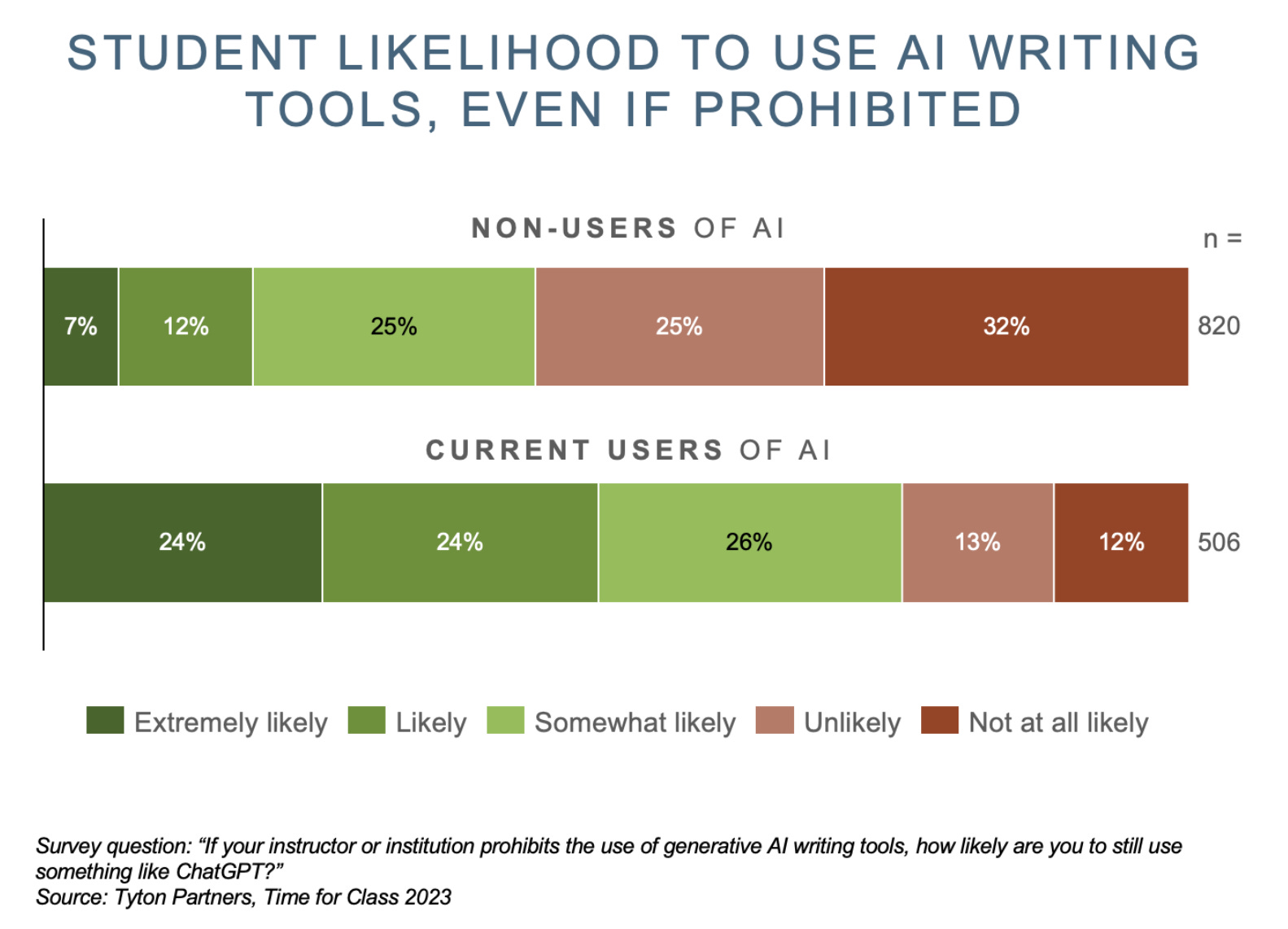
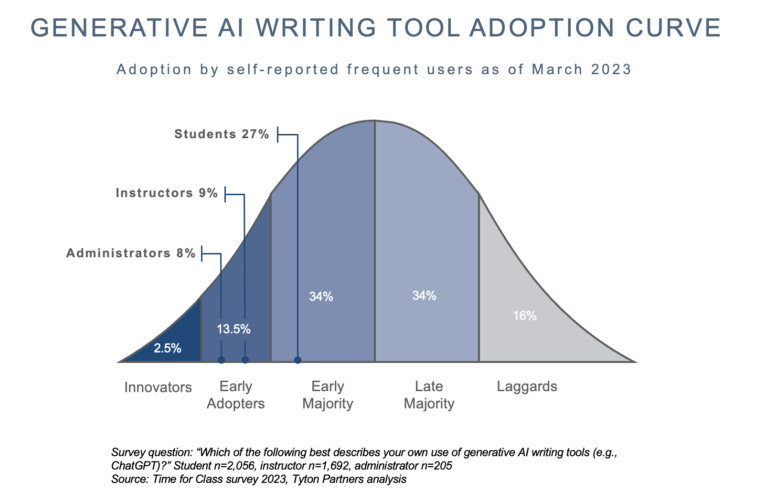
Adoption: College students have rapidly adopted GenAI into their academic toolkit. A survey conducted last spring found that one in three students was using GenAI. The actual percentage is likely higher and rising, given GenAI’s capability to enhance productivity for students yearning for an academic edge in their highly-competitive, time-constrained environment. In most cases, students are exploring GenAI without direction or training, as institutions have yet to formalize these types of supports. This institutional gap has not deterred students eager to capitalize on GenAI’s potential. College students have discovered such utility in GenAI that 51% of all college students and 69% of current student GenAI users vow to continue their usage even if banned by their administrators.
Perspective: Students are presently conflicted over the ethics of GenAI usage. A March survey found that 51% of college students believe “using AI tools to complete assignments and exams constitutes cheating or plagiarism.” Still, 20% of students admit to harnessing the power of GenAI to complete exams and assignments. Astonishingly, only 31% report having a written policy from their instructors, syllabi, or administration, leaving students to navigate the GenAI landscape independently. This rapid embrace of GenAI has left a lingering question in the minds of 40% of students, who fear that specific uses of GenAI could undermine the fundamental purpose of education. Student perspectives diverge between those who advocate for GenAI’s potential to enhance learning and productivity and those who emphasize its potential for diminished critical thinking and plagiarism.
Opportunities:
On-Demand Personalized Learning: GenAI-powered platforms can readily adapt to individual students’ needs, providing a personalized learning experience that can enhance formal instruction or supplement such instruction when students are outside the classroom.
Research Assistance: GenAI can expedite the student research process, especially in locating, summarizing, and organizing vast amounts of text and information. One new chatbot, Elicit, can cite and synthesize nearly any relevant publication.
Career Development: GenAI tools can simulate real-world practice, offering tangible training for various fields, including healthcare, business, and computer science. Harvard and Stanford recently launched a “Medical AI Bootcamp” to prepare medical students and doctors for the “intersection of AI and Medicine.”
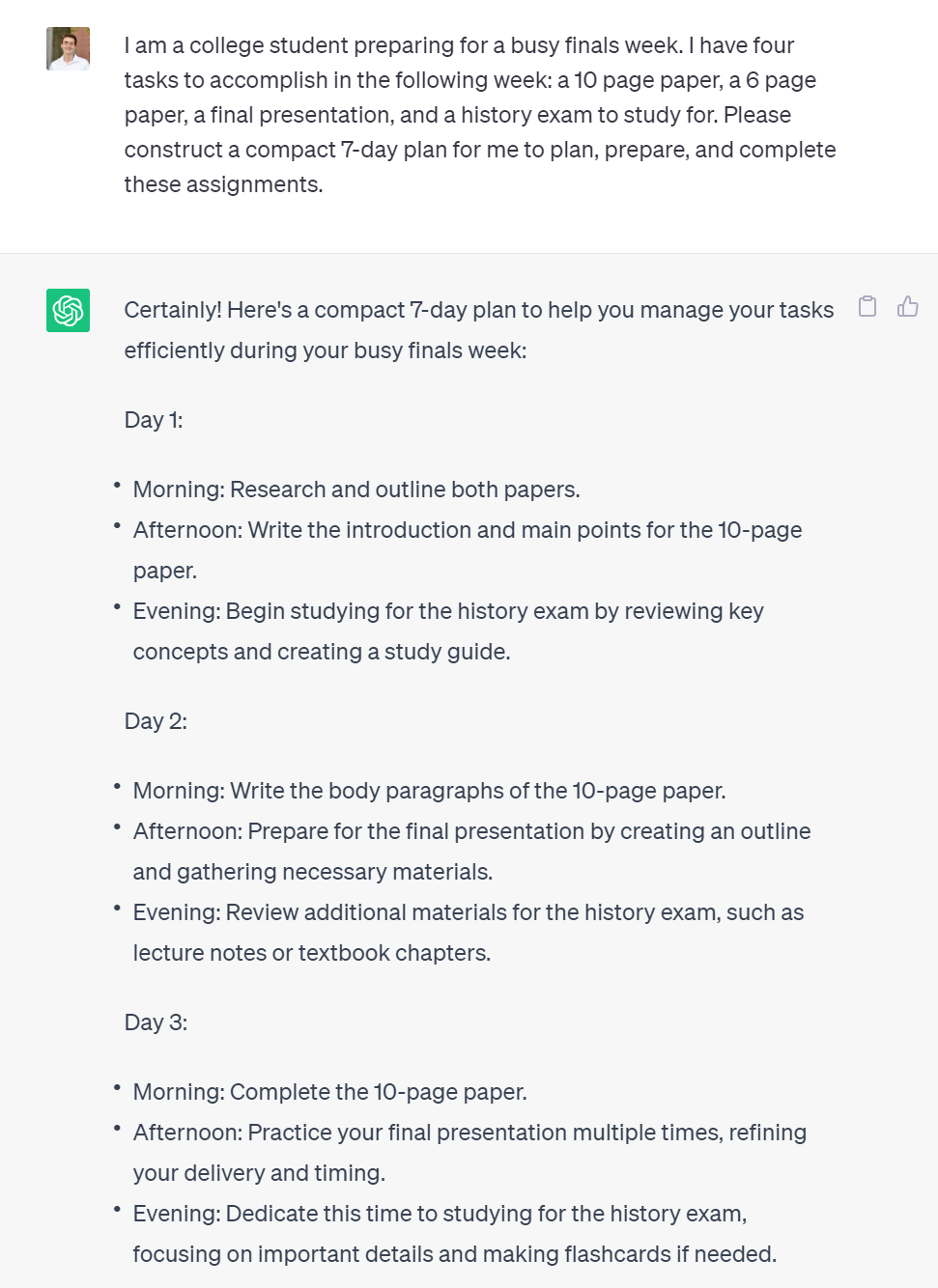
Time Management and Mental Health: Poor time management and “cramming” can increase stress and have negative impacts on mental health. GenAI can expedite work processes and assist in creating schedules that help students navigate heavy workloads. Consider a portion of ChatGPT response to a student’s prompt about preparing for finals week:
Risks:
Academic Integrity: Student cheating is now the number one concern of higher education instructors, up from 10th place only a year ago. Given GenAI’s ubiquity and the fast-paced, competitive campus environment, students now have the motive and means to plagiarize.
Reduced Critical Thinking: GenAI can empower students to create new ideas. It also risks supplanting their ability to do so. Over-reliance on GenAI tools may diminish students’ ability to think critically, solve complex problems independently, and write effectively.
Inequitable Opportunities: GenAI outputs could carry implicit or explicit biases that could result in discrimination based on race, gender, disability, culture, spoken language, etc.
Destabilized Job Markets: GenAI’s looming - but still not entirely understood - economic and workforce impacts necessitate that students develop a deeper understanding of this technology. I will also heighten the pressure that students feel about pursuing academic paths with associated long-term job prospects immune - or insulated - to the impacts of GenAI.
Faculty
Adoption: Generally, most surveys indicate that faculty are lagging behind students in the adoption of GenAI, for instance:
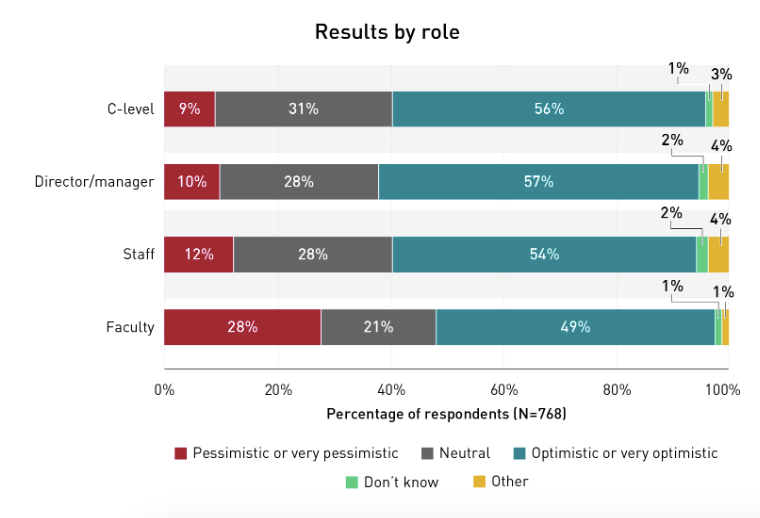
Perspective: Faculty seem to be concerned about GenAI. For instance, in a recent EDUCASE poll, over a quarter (28%) of faculty respondents indicated they are pessimistic or very pessimistic about the technology.
And…

Other faculty emphasize GenAI’s opportunities. Prof. Jamie O’Brien of St. Norbert College said, “Putting our heads in the sand won’t help students. AI is here to stay and is a powerful tool, so I take the approach of teaching them responsible usage while ensuring it doesn’t compromise their writing integrity…Higher education has an obligation to prepare students for a future with AI, but we aren’t doing enough.”
Opportunities
Learning Materials Development: GenAI can help create additive content (e.g., quiz questions, assessment criteria, and learning activities or lesson plans).
Timely Student Feedback and Assessment: GenAI can provide students with formative, automated feedback on technical aspects of writing, including, grammar, spelling, citation, and content structure.
Automating literature review: GenAI can quickly search through large amounts of literature and extract relevant information, saving time and resources for researchers.
Efficiencies: productivity gains are possible but will only be meaningful if they expand learning opportunities (e.g., more individualized student attention).
Risks
Inclusivity and Accessibility: Educators must build an inclusive and accessible learning environment that addresses students’ diverse needs and mitigates learning barriers. GenAI may make this more difficult as the data it is trained on could carry implicit or explicit biases that could result in discrimination based on race, gender, disability, culture, spoken language, etc.
Lack of Institutional Norms and Accountability Mechanisms: given the slow pace of higher-education decision-making, in many instances, educators will be left to create their own GenAI policies and enforce them.
Cost, privacy, legality, and ethics: associated with the use of GenAI systems (e.g., Faculty members’ use of artificial intelligence to grade student papers: a case of implications)
Ensuring Students are Learning: codifying the boundaries between cheating and augmenting work with GenAI will be difficult but imperative.
Out-of-date Curriculum: entire disciplines, e.g., computer science and engineering, will need to change fundamentally. Students currently learning coding language structures may be wasting their time and money.
Administration
Adoption: According to the surveys explored above, higher education administrators are the slowest to adopt GenAI into their daily practice.
Perspective: Administrators also seem to be concerned about the teaching and learning implications of GenAI. And while some college presidents are using GenAI symbolically, there needs to be more evidence that the technology is being utilized to augment existing administrative or operational processes.
Opportunities
Cost Savings: GenAI can automate or augment processes that are linked to the increase in administrative budgetary growth over the last three decades (e.g., student administration), freeing up financial resources for teaching and learning and other associated evidence-based interventions that improve the student experience.
Decision-Making: GenAI can support data-driven decisions by diving deep into student performance, enrollment trends, and other key metrics.
Research opportunities: new funding opportunities, particularly institutions with existing AI and computer science programs.
Risks
Slow to Move: taking too long to provide faculty with guidelines for utilizing and enforcing the use of GenAI in the classroom will exacerbate learning challenges for students and diminish the upside of GenAI use.
Skills Misalignment: continuing to train students for jobs likely to be augmented by GenAI.
Our Conclusion and Observations
So, does the adoption of GenAI represent a fundamentally destabilizing event for higher education? Given the pace of adoption and the complexity of the current operating environment, the answer is yes. GenAI will bring risk and opportunity in equal measure. To optimize for the potential benefits of GenAI on campus and contain the downside, institutions should consider the following actions:
Be Crystal Clear on Academic Integrity:
Update academic conduct policies to account for GenAI with transparent guardrails for what is acceptable and what is not.
Provide Guidance, Strategies, and Training for Faculty to Support Student Learning:
Create guidelines, strategies, and training opportunities to prepare faculty to articulate and enforce the appropriate use of GenAI in the classroom while task forces - or similar administrative bodies - create formal policies. At minimum, this guidance should include strategies that help individual faculty members and academic departments build expectations for using or not using GenAI across assignments and research.
Help Students Build GenAI Literacy:
Create free, easily accessible, evidence-based tools to help students develop fundamental skills and utilize best practices related to GenAI use (e.g., how to write effective prompts).
Take Administrative Action:
America's confidence in higher education has fallen to a historic low. The use of GenAI has to be about more than teaching and learning. It must also be about administrative and operational innovation that improves the student experience aligned with each institution’s mission. Higher education institutions that use GenAI to innovate will dramatically outpace competitors.